
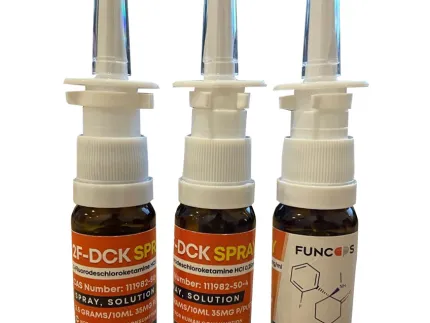
2F‑Ketamine Spray 25 % — Analytical Reference Material
2F‑Ketamine Spray 25 % (2‑fluorodeschloroketamine, 2‑FDCK) is a fluorinated arylcyclohexanone analogue of ketamine.
It is primarily employed under license for analytical method development, forensic toxicology calibration, and comparative metabolic profiling of arylcyclohexylamine derivatives.
The 25 % spray formulation is used in quality‑controlled research environments for precision spray dispensing tests involving aerosol distribution and mass spectrometry validation.
Organic / Inorganic Chemistry
| Property | Information |
|---|---|
| IUPAC Name | 2‑(2‑fluorophenyl)‑2‑(methylamino)cyclohexan‑1‑one |
| Molecular Formula | C₁₃H₁₆FNO |
| Molecular Weight | 221.27 g mol⁻¹ |
| Chemical Class | Arylcyclohexylamine derivative of ketamine |
| Functional Groups | Aryl fluoride, ketone, secondary amine |
| Physical Form | Clear or slightly turbid liquid solution (25 % w/v in ethanol or saline) |
| Melting Point (HCl salt) | ≈ 184 – 186 °C |
| Boiling Point (free base) | ≈ 350 °C (decomposes) |
| Solubility | High in polar organic solvents (methanol, ethanol, acetonitrile) · Low in non‑polar media |
| Stability | Stable when sealed; light and moisture sensitive in open conditions. |
Chemical Biology
- Pharmacological Category: NMDA receptor antagonist class of arylcyclohexylamines.
- Intended Research Use: Comparative studies on structure‑activity relationship (SAR) and analytical toxicology profiling.
- In Vitro Studies: Shows reduced N‑demethylation compared to ketamine due to fluorine substitution; experimental metabolite 2F‑norketamine noted in CYP3A metabolomic assays.
- Protein Interactions: Model ligand for computational binding studies on glutamatergic ion channels.
- Bio‑Safety Handling: Treat as a controlled dissociative agent with neuro‑modulatory activity analogous to ketamine.
Computational Chemistry
| Descriptor | Value (B3LYP/6‑31G*) |
|---|---|
| Dipole Moment | 3.45 D |
| HOMO–LUMO Gap | 5.7 eV |
| log P (pred.) | 3.1 |
| pKa (amine) | ≈ 8.5 |
| Topological Polar Surface Area (TPSA) | 29 Ų |
| Rotatable Bonds | 2 |
| Predicted Binding Energy (NMDA channel) | ≈ –9.1 kcal mol⁻¹ |
| Computational Comment: The ortho‑fluoro group induces a steric twist reducing planarity vs ketamine, affecting binding orientation in protein‑ligand simulations. |
Environmental Chemistry
- Hydrolytic Stability: High resistance to hydrolysis at pH 5–9; slow decomposition under alkaline conditions.
- Photodegradation: Moderate; fluorine substitution slows UV decay.
- Bioaccumulation Potential: Medium (log Kow ≈ 3.1).
- Degradability: Low; expected persistence in soil and water.
- Environmental Disposal: Neutralize chemically (e.g., oxidative treatment) then incinerate > 1100 °C.
Laboratory Equipment
| Instrument | Analytical Application |
|---|---|
| LC–MS/MS (ESI+) | [M+H]⁺ = 222 m/z · major fragments: 204 (–H₂O), 186 (demethylated). |
| GC–MS (EI) | M⁺ = 221 m/z · base peak 179 m/z (aromatic fragment). |
| FTIR (ATR) | C=O stretch 1680 cm⁻¹ · C–F stretch 1230 cm⁻¹ · N–H bend 3500 cm⁻¹. |
| ¹H NMR (CDCl₃) | δ 7.0–7.4 (aromatic) · 2.9 (methylamine) · 2.3 (CH₂‑CO). |
| Chromatography QC | C18 column · MeOH/H₂O (70:30 + 0.1 % formic acid) · Retention time ≈ 4.5 min. |
| Storage Condition: Keep sealed ≤ –20 °C, protected from light and moisture. |
Consumables & Support Materials
- LC–MS grade methanol / acetonitrile / formic acid.
- Volumetric spray flasks and certified micropumps.
- Amber storage bottles (PTFE lined).
- Desiccant packs for humidity control.
- Full PPE (P3 mask, nitrile gloves, lab coat, safety goggles).
Regulation & Safety
| Category | Guidance |
|---|---|
| Controlled Status | Schedule I analogue (US Federal Analogue Act) · Class B (UK MDA 1971) · Schedule 9 (Australia). |
| Intended Use | Research and analytical work under licensed approval only. |
| GHS Signal Word | Danger |
| Hazard Statements | H301, H311, H331 – Toxic if swallowed, in contact with skin or inhaled. |
| Precautionary Measures | Work in fume hood · Avoid aerosol formation · Use sealed dispensing systems. |
| First Aid | Flush contaminated areas ≥ 15 minutes; seek immediate medical attention. |
| Waste Disposal | Chemical neutralization followed by licensed incineration. |
Chemical Informatics
| Descriptor | Data |
|---|---|
| SMILES | CN(C1(CCCCC1)C(=O)C2=CC=CC=C2F) |
| InChIKey | LQKQZQVISTWWTH‑UHFFFAOYSA‑N |
| TPSA | 29 Ų |
| Rotatable Bonds | 2 |
| **log P ** | 3.1 |
| Molecular Mass | 221.27 g mol⁻¹ |
| Applications | Toxicology databases, MS reference libraries, QSAR & ADMET dataset entries. |
Legal & Ethical Statement
⚠️ Controlled‑Substance Notice
2F‑Ketamine is regulated as a dissociative arylcyclohexylamine analogue.
Handling requires appropriate government authorization and record‑keeping under controlled substance regulations.
This information is provided for scientific documentation, regulatory compliance, and educational reference, not promotion or sale.
Be the first to review “2F-Ketamine Spray 25%”
Related products

Research Chemicals
Research Chemicals

Research Chemicals

Research Chemicals

Research Chemicals
Research Chemicals
Research Chemicals

Research Chemicals
Reviews
There are no reviews yet.