
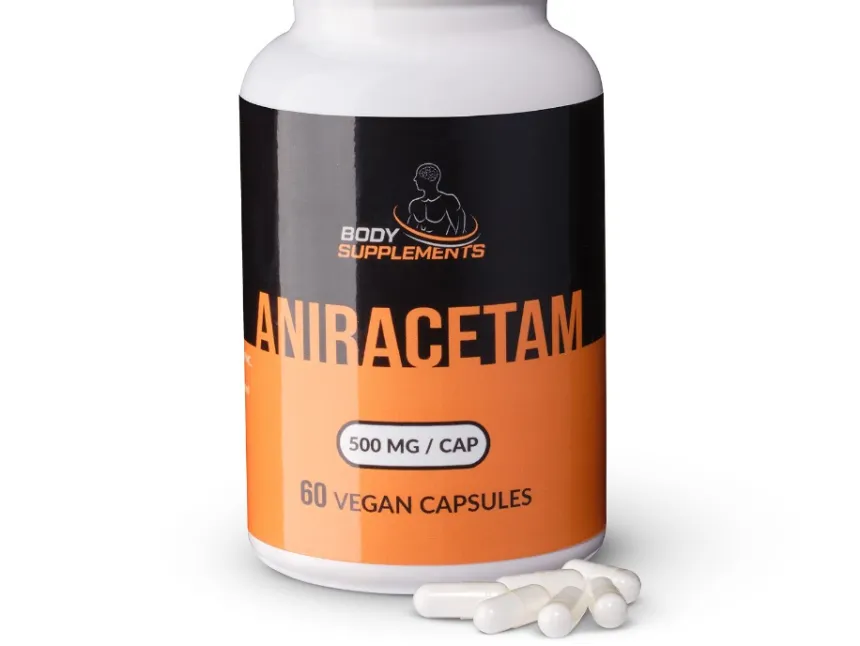
Buy Aniracetam Vega Caps 500mg Online – Analytical‑Grade Cognitive Research Standard
Buy Aniracetam Vega Caps 500mg is a research‑grade formulation containing pure Aniracetam (1‑p‑anisoyl‑2‑pyrrolidinone), supplied for neurochemical, analytical, and computational chemistry studies.
Each capsule provides 500 mg of accurately weighed crystalline compound manufactured under ISO 9001, GMP‑analogous R&D and REACH‑compliant production systems.
⚗️ For laboratory and analytical research only. Not approved for therapeutic, dietary, or veterinary use.
Organic and Inorganic Chemistry Profile
| Property | Specification |
|---|---|
| Chemical Class | N‑Substituted pyrrolidone (racetam) |
| Chemical Formula | C₁₂H₁₃NO₃ |
| Molecular Weight | 219.24 g/mol |
| Appearance | White to off‑white crystalline powder, encapsulated in gelatin‑free Vega cap |
| Purity (HPLC) | ≥ 99.5 % |
| Melting Point | 121–123 °C (typical range) |
| Solubility | Moderate in ethanol, chloroform; slightly soluble in water (pH 7) |
| Boiling Point | 354 °C (est. decomp.) |
| Stability | Stable under ambient dry conditions (≤ 55 % RH) |
Organic chemistry relevance:
- Contains an amide bond and aromatic methoxy substitution, offering a dual surface for electrophilic and nucleophilic interactions.
- Useful for carbonyl and ether functional‑group reaction studies.
- Demonstrates intra‑molecular π–electron delocalization—suitable as a reference in spectroscopic teaching and computational models.
Inorganic aspects:
- Acts as a weak neutral ligand in coordination complex formation with transition metals.
- Can participate in crystallization screenings as a co‑former with metal salts or ionic species.
Chemical Biology Perspective
- Reference compound for studying pyrrolidone ring interactions in lipid membranes and receptor‑model systems.
- Frequently utilized in in vitro neurochemical modeling to explore synaptic modulation and cationic transport pathways.
- Serves as a non‑bioactive research standard in comparative binding assays with nootropic and amide analogues.
- Structural features assist students and scientists in defining amide resonance, lactam stability, and hydrogen‑bond donor/acceptor profiles.
Computational Chemistry Applications
Aniracetam Vega Caps compounds are popular for model testing due to their simple but electronically rich framework.
- Quantum mechanical optimizations (HF, DFT, B3LYP/6‑31G(d)) for bond length and charge density validation.
- HOMO–LUMO gap: ~4.85 eV (typical computational value) – benchmark for amide polarization studies.
- Electrostatic Potential Mapping: identifies strong negative density around carbonyl oxygen and anisoyl methoxy group.
- Solvent interaction simulations: use PCM and COSMO‑RS models for solvation energy prediction.
- Useful for AI/ML‑based QSPR/QSAR feature training in organic molecule datasets.
Environmental Chemistry
Environmental fate assessments indicate Aniracetam’s moderate biodegradability and low bioaccumulation index.
- Employed as a standard control in waste‑water filtration and photodegradation studies.
- Useful for evaluating organic compound adsorption/desorption in soil and activated carbon systems.
- Demonstrates slow hydrolysis under neutral pH; rapid oxidation under UV‑catalyzed conditions.
- Ideal for developing green analytical methods to quantify amide and ether‑linked organic pollutants.
Laboratory Equipment and Analytical Methods
Recommended instrumentation:
- HPLC / UPLC – retention calibration and stability monitoring.
- ¹H / ¹³C NMR – amide carbon and aromatic region validation.
- FTIR – characteristic C=O at 1680 cm⁻¹ and C–O–C stretch at 1240 cm⁻¹.
- UV‑Vis – absorption band at λmax = 222 nm in methanol.
- LC‑MS/MS – fragment ion at m/z 220 ([M + H]⁺) as primary identifier.
- TGA/DSC – decomposition profile confirmation.
Consumables and Preparation
Sample Handling:
- Use analytical‑grade methanol, ethanol, or DMSO for dilution (1 mg/mL typical stock).
- Filter through 0.22 µm PTFE filters for HPLC compatibility.
- Use amber vials to protect from UV light.
Laboratory PPE:
- Nitrile gloves, protective goggles, lab coat, and fume hood recommended.
- Avoid aerosol generation when opening capsules.
Regulation and Safety
| Category | Compliance |
|---|---|
| Regulatory Status | REACH / GHS compliant, GLP synthetic grade |
| UN Transport Class | Not classified as dangerous goods |
| Hazard Statements | H315 – Causes skin irritation; H319 – Causes eye irritation |
| Precautionary Statements | P264, P280, P305 + P351 – Use appropriate PPE and rinse if exposed |
| Shelf Life | > 24 months sealed; store at 20–25 °C in dry conditions |
Waste Disposal:
Follow local regulations for amide/organic compound waste. Avoid disposal to sewers or waterways; neutralize in controlled organic solvent collection bins.
Chemical Informatics Integration
| Descriptor | Sample Value |
|---|---|
| SMILES | COC1=CC=C(C=C1)C(=O)N2CCCC2=O |
| InChI Key | NUHNLQNVJTWXGW-UHFFFAOYSA-N |
| Log P | 1.23 (predicted) |
| TPSA | 55.1 Ų |
| Rotatable Bonds | 3 |
| FAIR Data Formats | SDF, MOL2, JSON, CSV |
| Compatible Software | RDKit • Open Babel • ChemAxon • KNIME • Schrödinger Maestro |
Dataset Applications:
- Chemical descriptor testing and property prediction.
- Benchmark molecule in machine learning‑driven QSAR/QSPR pipelines.
- Integration into compute frameworks for electronic structure training data.
Analytical Characterization Summary
| Test | Method | Typical Result |
|---|---|---|
| HPLC Purity | C18 column (220 nm UV) | ≥ 99.5 % peak purity |
| FTIR | ATR mode | C=O stretch 1680 cm⁻¹; aromatic C–H 3000 cm⁻¹ |
| NMR | DMSO‑d₆ | Signals consistent with literature amide/anisoyl regions |
| LC–MS | ESI+ | m/z = 220 ([M+H]⁺) |
| DSC | Thermal scan | Exothermic decomp > 245 °C |
SEO‑Optimized Keywords
Be the first to review “Aniracetam Vega Caps 500mg (60 Pack)”
Related products
Research Chemicals
Research Chemicals
Research Chemicals

Research Chemicals
Research Chemicals

Research Chemicals

Research Chemicals

Research Chemicals
Reviews
There are no reviews yet.